
Customer journey orchestration: A practical guide
How customer journey orchestration works, why CRM matters, and how teams turn data into coordinated experiences
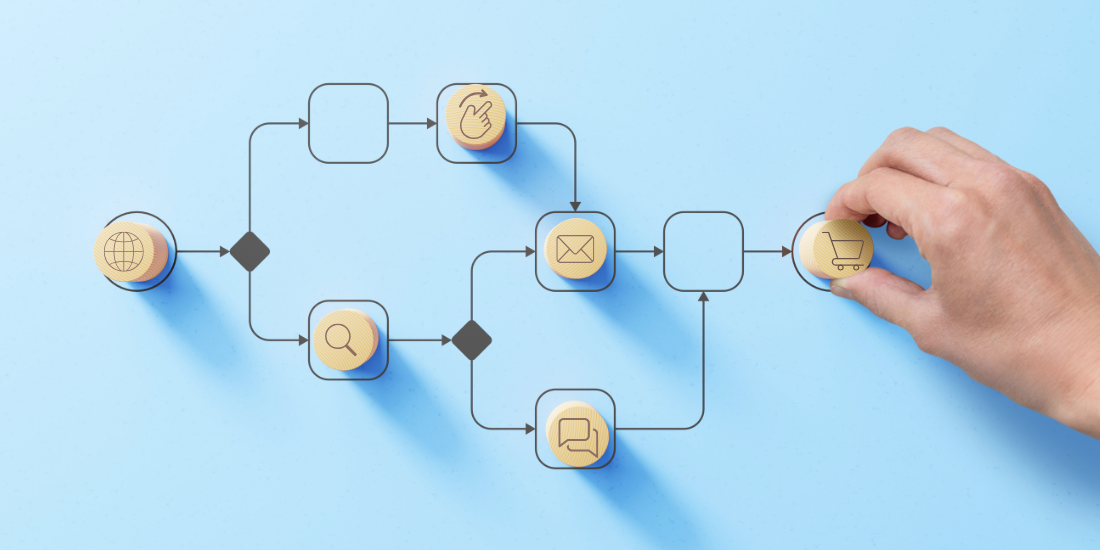
While many organizations possess journey maps, CRM systems, and automation tools, effectively executing them remains a significant challenge. Customer journey orchestration addresses this gap by enabling organizations to translate strategy into real-time action. By doing so, it drives measurable business outcomes such as increased revenue, greater customer retention, and improved customer satisfaction. This highlights the strategic value of orchestration for executives looking to enhance their organization's performance.
Customer journey orchestration integrates customer data, real-time signals, and cross-channel interactions to guide each stage of the customer experience. This approach allows organizations to move beyond static journeys and deliver interactions informed by actual behavior, preferences, and historical context.
The customer relationship management (CRM) platform is central to this process, providing unified customer profiles and interaction histories that inform orchestration decisions. With CRM as the foundation, teams can coordinate journeys across marketing, sales, and service channels, thereby enhancing consistency and reducing operational barriers.
What is customer journey orchestration?
Customer journey orchestration is the real-time coordination of customer engagements across channels, guided by data and rules to determine the next-best action.
Journey mapping outlines the intended experience, while orchestration operationalizes it in real time.
Learn more about the difference between mapping and orchestrating here.
How does customer journey orchestration improve the customer experience?
1. It makes experiences feel more connected.
Customers often move between web, mobile, messaging, and the contact center within a single journey. Orchestration helps keep these handoffs aligned so customers don’t have to provide the same information again or restart tasks. Without orchestration, customers often experience what we call the Dory Effect — interactions that reset every time they switch channels.
2. It ensures data is applied ethically.
A structured orchestration framework enhances governance by specifying the appropriate use of customer data, identifying actions that require consent, and maintaining consistent communication.
3. It standardizes how teams deliver journeys.
Marketing, sales, and service teams often manage their own workflows. Orchestration helps unify them so interactions are consistent across departments. Coordinated journeys across teams can also turn service interactions into timely, relevant revenue opportunities.
How does customer journey orchestration work across channels?
Orchestration uses CRM data and real-time behavioral signals to determine what should happen next in a customer’s experience.
These actions can apply to digital channels, human-assisted interactions, or both. But generally, orchestration matters most when digital and human interactions influence each other, not when they operate in isolation.
Examples of journey orchestration in action
Journey orchestration uses customer data and real-time signals to guide interactions across digital and human-assisted channels.
The table below illustrates how orchestration works across common touchpoints.
The value of journey orchestration lies in applying consistent decision-making across channels rather than managing each channel in isolation.
What tools support customer journey orchestration?
Most organizations use CRM alongside an orchestration platform or workflow engine. The best approach depends on the systems already in place and the types of journeys the team wants to support.
- Salesforce: Provides tight orchestration across sales, marketing, and service data, streamlining decision-making for organizations focused on integrating these functions.
- Microsoft: Dynamics 365 offers real-time journey management and unified customer profiles , with enhanced capabilities when combined with strong data governance.
- Genesys: Orchestrates routing, agent workflows, and proactive service within the contact center, while other tools may focus on different orchestration aspects.
- ServiceNow: journeys across service, sales, and IT workflows, enabling coordination of processes and data beyond traditional contact centers.
- Pega: Delivers real-time, AI-powered decisioning to guide next-best actions across channels for a coordinated customer journey.
The right orchestration approach relies less on the platform and more on where real-time decisions are needed inside marketing workflows, service interactions, or both.
When selecting the optimal orchestration strategy, leaders should consider key factors such as aligning the solution with specific business goals and assessing the organization's data maturity. By evaluating these elements, organizations can tailor their orchestration approach to best meet their strategic objectives and operational capabilities.
[cta-1]
How does TTEC Digital structure customer journey orchestration?
Journey orchestration often breaks down when organizations design around internal teams, systems, or channels instead of customer outcomes. TTEC Digital’s approach starts with the customer and works backward to align data, platforms, and operations.
While each implementation is adapted to the client, our orchestration work typically follows four core phases used across TTEC Digital programs:
- Data collection and analysis - Understanding existing data sources, quality, and gaps. This forms the foundation for unified customer profiles.
- Journey visualization - Mapping current and future-state flows to understand friction points and opportunities.
- Journey design and optimization - Designing workflows, rules, and content that support customer needs and business goals.
- Orchestration and measurement - Activating real-time coordination across channels and building dashboards to track performance.
What differentiates TTEC Digital’s approach is the integration of CX strategy, platform expertise, and operational execution. We ensure journeys don’t stop at design but perform reliably at scale.
Learn more about our approach to CX strategy & design here.
How do organizations measure the success of customer journey orchestration?
Most orchestration programs track a mix of experience and business outcomes. A common mistake is measuring individual channels in isolation. Journey orchestration shifts focus to the journey level, evaluating whether customers progress, stall, or divert, and why.
Effective journey-level KPIs can directly link to critical business goals. For instance, by improving conversion rates and engagement, organizations can drive revenue growth. Similarly, enhancing customer satisfaction scores contributes to better retention. Measuring the efficiency of business processes, such as accurate routing and reduced handle time, can result in operational improvements and cost savings. This approach helps executives understand the strategic importance of measurement.
Common journey orchestration KPIs
Organizations typically track journey-level metrics such as:
- Conversion rate
- Engagement rate
- CSAT or NPS
- Retention and repeat behavior
- Business process efficiency (routing accuracy, reduced handle time, higher containment)
CRM reporting considerations
To measure journey performance effectively, teams often:
- Define clear journey objectives.
- Map necessary CRM fields to each step.
- Build dashboards showing progress and drop-off points.
- Use journey timelines to analyze behavior patterns.
What are the top mistakes teams make when implementing journey orchestration?
Many customer journey orchestration initiatives stall not because of technology, but because teams make avoidable implementation mistakes early on. Here are a few of the most common ones we see:
- Automating without personalization
Automations should be informed by customer context. Otherwise, they can feel repetitive or irrelevant. To mitigate this, gather detailed customer data to personalize interactions dynamically and ensure relevance.
- Overestimating data requirements
Many teams delay journey orchestration while waiting for perfect data. While data quality matters, orchestration can begin with partial profiles and improve over time as signals accumulate. Starting with pilot programs can enable iterative data enhancement without requiring perfection.
- Limited testing
Journey orchestration should evolve based on insights, requiring regular testing and iteration. To address this, establish a continuous feedback loop that tests and refines journeys based on real-world results and user feedback.
- Lack of governance
Without clear ownership, consent rules, and escalation paths, orchestration can create inconsistency instead of clarity. Avoid this by assigning a dedicated team responsible for oversight and compliance, ensuring clear rules and pathways are in place.
Customer journey orchestration FAQ
Q. What is the difference between journey orchestration and CRM automation?
A. CRM automation manages predefined workflows, such as sending an email after a form fill. Journey orchestration goes a step further by guiding the next interaction based on real-time data and customer behavior, even when journeys don’t follow a predictable path.
Q. Can CRM support orchestration on its own?
A. CRM provides the unified customer profile and interaction history that orchestration depends on. However, most organizations use a dedicated orchestration engine to evaluate signals and make decisions instantly across channels, especially when timing matters.
Q. Which industries benefit most from journey orchestration?
A. Industries with complex, multi-step, or high-frequency customer interactions see the greatest benefit from journey orchestration. Financial services, healthcare, retail, travel, public sector, and subscription-based businesses all fit this bill because they rely on coordinated data and timely decisions to manage handoffs, personalize interactions, and adapt as customer needs change.
Q. What’s the difference between journey orchestration and a campaign?
A. Customer journey orchestration is a continuous, event-driven approach that responds to customer behavior as it happens. Campaigns, by contrast, are usually planned in advance and delivered on a fixed schedule. Orchestration adapts in real time, while campaigns are designed to run as planned.
Q. Does customer journey orchestration include personalization, and how is it different from personalization tools?
A. Journey orchestration uses personalization data, such as behavior and preferences, but focuses on coordination rather than content selection alone. A personalization tool might decide what message to show, while orchestration determines when to act, where the interaction should occur, and whether it should happen at all.
Making customer journey orchestration operational
Customer journey orchestration is not a single tool, campaign, or workflow. It is an operating capability that connects data, decisions, and interactions across the moments that matter most to customers.
When supported by a strong CRM foundation, clear governance, and ongoing optimization, orchestration helps organizations move beyond disconnected journeys and deliver experiences that adapt in real time across channels, teams, and customer needs.
To embark on this journey confidently, decision-makers should focus on initial actions such as assessing current customer journeys to identify gaps and opportunities, aligning stakeholders across departments to ensure consistent objectives, and investing in team training to build the requisite skills for effective orchestration.
[cta-2]
Put customer journey orchestration into practice.
Learn how organizations design, activate, and optimize orchestrated journeys across channels, data, and teams with practical guidance.
Technology alone won’t close the customer experience gap.
Why CX success depends on aligning strategy, systems, and execution — not just investing in more tools.