
The unseen data risk threatening your AI investments
Our research reveals why privacy restrictions and unclear data stewardship are capping AI ROI — and how to fix it.

Only a couple of years ago, AI readiness meant struggling with raw, messy data. When we asked CX leaders about AI readiness in 2023, 80% cited data quality as a primary obstacle.
Today, thanks to major investments in data classification, enrichment, and preparation, the data quality challenge has largely been solved. But as attention shifts from preparing for AI to scaling it, a new readiness gap has taken its place: data governance.
The data governance blind spot
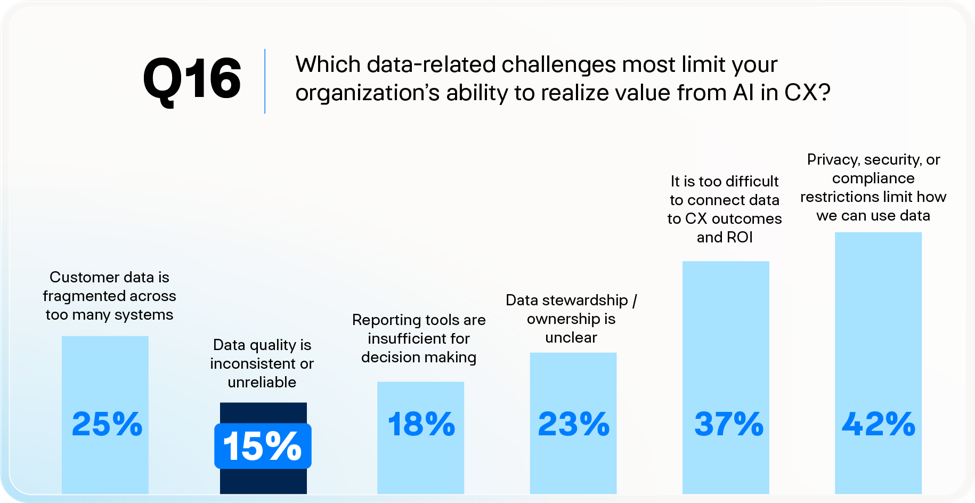
When asked which data-related challenges most limit their ability to realize value from AI in CX leaders cited:
- Privacy, security or compliance restrictions: 42%
- Difficulty connecting data to CX outcomes and ROI: 37%
- Data fragmentation across too many systems: 25%
- Unclear data stewardship/ownership: 23%
- Inconsistent or unreliable data quality: 15%
What aren't they talking about enough? Governance — the explicit set of rules, policies and roles used to ensure customer datais stored and used responsibly across every AI touchpoint.
In that same survey, only 11% of respondents explicitlyidentified governance policies as a significant standalone challenge, placingit among the least-cited concerns. In my opinion, that is a massive blind spot.
When governance is inconsistent or informal, every new AIinitiative becomes a debate over which data can be used, who has authority toapprove it, and how success should be measured. The result is higher securityand compliance risk with every token spent — and a much steeper path to provingAI ROI.
Why modern AI needs modern governance
Whenever I talk with CX executives about enterprise AI, I remind them: successful AI deployment isn't about having the newest or smartest AI model. It’s about controlling the rails that those agents run on — and that comes down to data and governance.
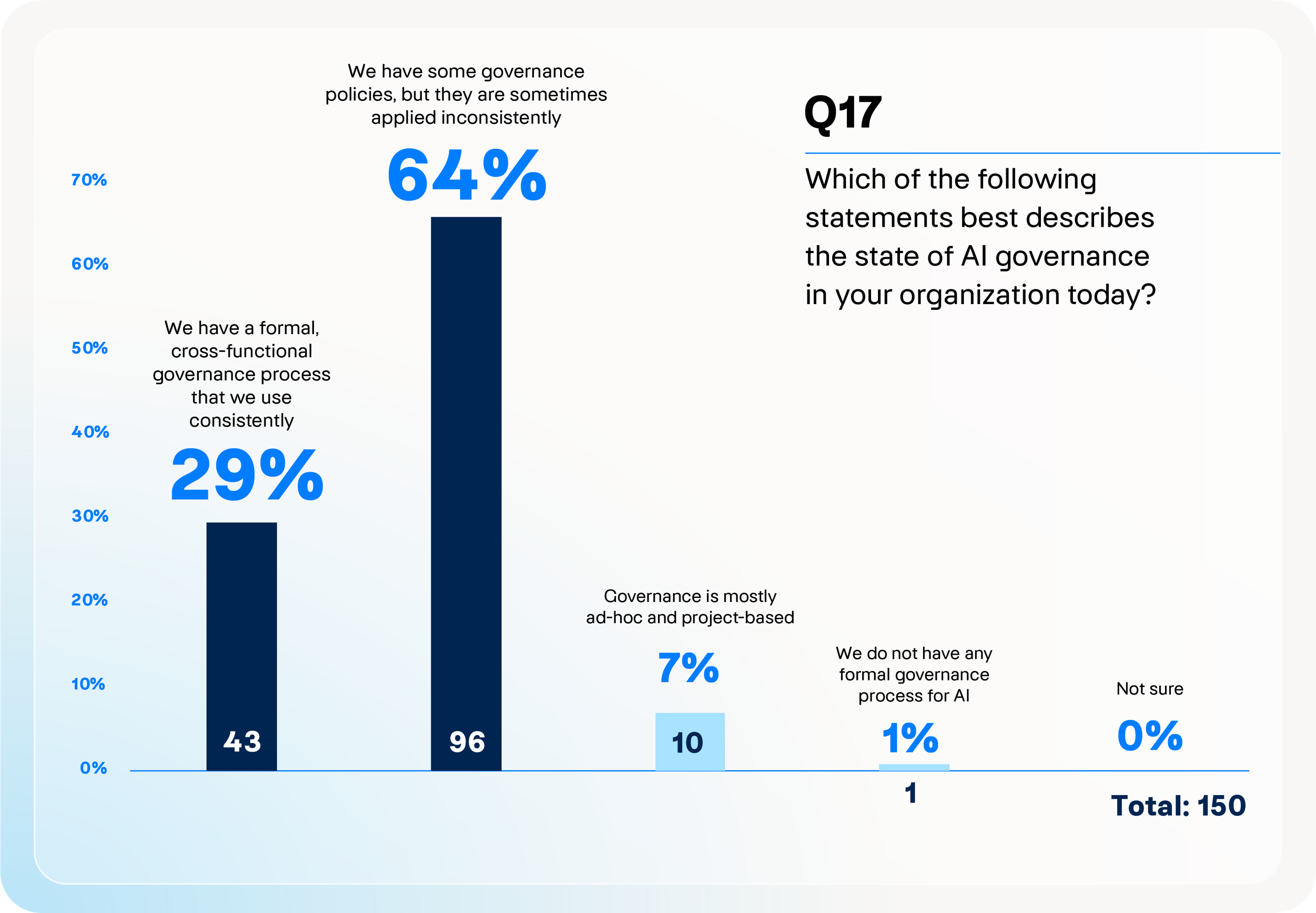
While 64% of organizations report having governance policies on paper, nearly three-quarters fail to enforce them consistently. A decade ago, that might not have mattered. Automation was built on static rules. Customer journeys were scripted, and often rigidly so. And when the rules failed, the breakdown was obvious — a workflow halted, or a process crashed.
Modern AI agents operate far more autonomously, requiring tighter guardrails, controlled data access, and continuous observability. This means that AI doesn't fail predictably; problems emerge subtly through hallucinated answers or unapproved data access, often going unnoticed until a customer points them out to you or, worse, shares them publicly.
3 steps to elevate CX AI governance
Fortunately, governance doesn't require the kind of sweeping transformation that many data quality initiatives demanded. For most CX teams, it's about embedding visibility into everyday operations using a standard "medallion" architecture:
- Bronze layer (raw ingestion): Capturing customer touchpoints across fragmented channels.
- Silver layer (cleaning & integration): Resolving customer identities, eliminating duplicate records, and standardizing formatting.
- Gold layer (governed activation): Feeding tightly controlled, fully permissioned data directly to autonomous AI models.
And to make governance an active part of your business's operating rhythm, focus on three practical starting points:
- Make ownership clear from the start. Before deploying a new virtual agent, automation or agent assist capability, define who owns the initiative, who can approve data access, and who is accountable for outcomes. Many governance problems begin when ownership is unclear.
- Create a cross-functional checkpoint for AI decisions. Bring together product, operations, technology, data, security, compliance, and marketing leaders on a regular basis. These conversations help identify governance risks (and also best practices), before they become customer-facing problems.
- Audit AI performance as rigorously as human performance. Most organizations closely monitor employee performance but treat AI differently. Review AI outputs regularly, measure their impact on business and customer outcomes, and investigate unexpected behavior before it affects customers.
“Confident AI adopters are 47% more likely to run a formal governance process consistently.”
- The great CX reset, TTEC Digital + CX Dive, 2026
Laying the track for sustainable AI scale
When examining survey data and client conversations, the central challenge becomes clear: scaling AI isn't a tech race — it's an operational one.
Speed doesn't matter if your virtual agents are leaking bad data or making unvetted promises. True scale happens when governance is built into your everyday operating rhythm — giving your teams the confidence to roll out new use cases without second-guessing security, compliance, or output quality.
By making governance a standard business habit rather than a one-time approval gate, you protect your customer relationships and unlock the true value of your AI investments.
[cta-1]
Want help building your AI-ready data foundation?
Learn how TTEC Digital’s CX Data Insights offering unifies customer data and strengthens governance across your AI touchpoints.

Marcy specializes in data-driven decisioning for exceptional customer experiences. Her expertise spans analytics, AI, machine learning, and data visualization.
