
From stop sign to gas pedal: Turning AI governance into a growth engine

As AI adoption accelerates, one critical element remains misunderstood and often feared: governance. For many organizations, AI governance evokes images of bureaucracy, delays, and restrictions. In other words, it’s viewed as an unwelcome stop sign on the road to innovation.
This perception has real consequences. Three years into the AI boom, only 43% of organizations have a formal governance policy in place. Another 25% are still working to implement one, while 29% have no governance framework at all.
Part of the problem lies in legacy thinking. In customer experience (CX), governance has traditionally been led by compliance and risk teams focused on minimizing exposure. While this zero-risk mindset may have shielded organizations from short-term harm, it has also stifled innovation — especially when it comes to emerging technologies like AI.
The result? AI initiatives either stall due to uncertainty or launch without safeguards, leading to inconsistent outcomes, missed opportunities, and ironically, slower progress than if governance had been in place from the outset.
But what if we viewed governance not as a brake, but as the gas pedal?
The pitfalls of passive AI governance
Before we take a closer look at how governance accelerates AI innovation, look at what happens when it’s absent or reactive.
1. Each investment is reviewed independently
Unlike mature technologies with stable ecosystems, AI evolves rapidly. Take the last year, for example. New capabilities emerged almost monthly, from generative models to multimodal systems and now autonomous agents. Governance must adapt as quickly as the technology it supports. A one-time strategy to help get an ad-hoc project off the ground won’t cut it. Organizations need frameworks that evolve alongside the technology, or they risk losing all the value they gained.
2. Fragmented adoption creates silos
Without centralized governance, departments tend to adopt AI independently of one another. Marketing might deploy a generative assistant, while customer service trials voice analytics, and sales experiments with AI-powered knowledge bases. These siloed efforts prevent cross-functional synergies. Insights from one project don’t inform others, limiting enterprise-wide impact and leaving a wake of disjointed customer experiences along the way.
3. Operational consequences multiply
Lack of governance makes it difficult to measure ROI, manage risk, and scale successful use cases. Shadow AI — tools adopted outside formal oversight — can proliferate, increasing exposure to compliance, security, and ethical risks. Without visibility, organizations lose control over their AI roadmap.
Building governance that accelerates innovation
Governance doesn’t have to be a bottleneck. In fact, when designed well, it becomes a catalyst for innovation. Here’s a framework we use with our clients that encourages responsible AI adoption while enabling speed and scale:
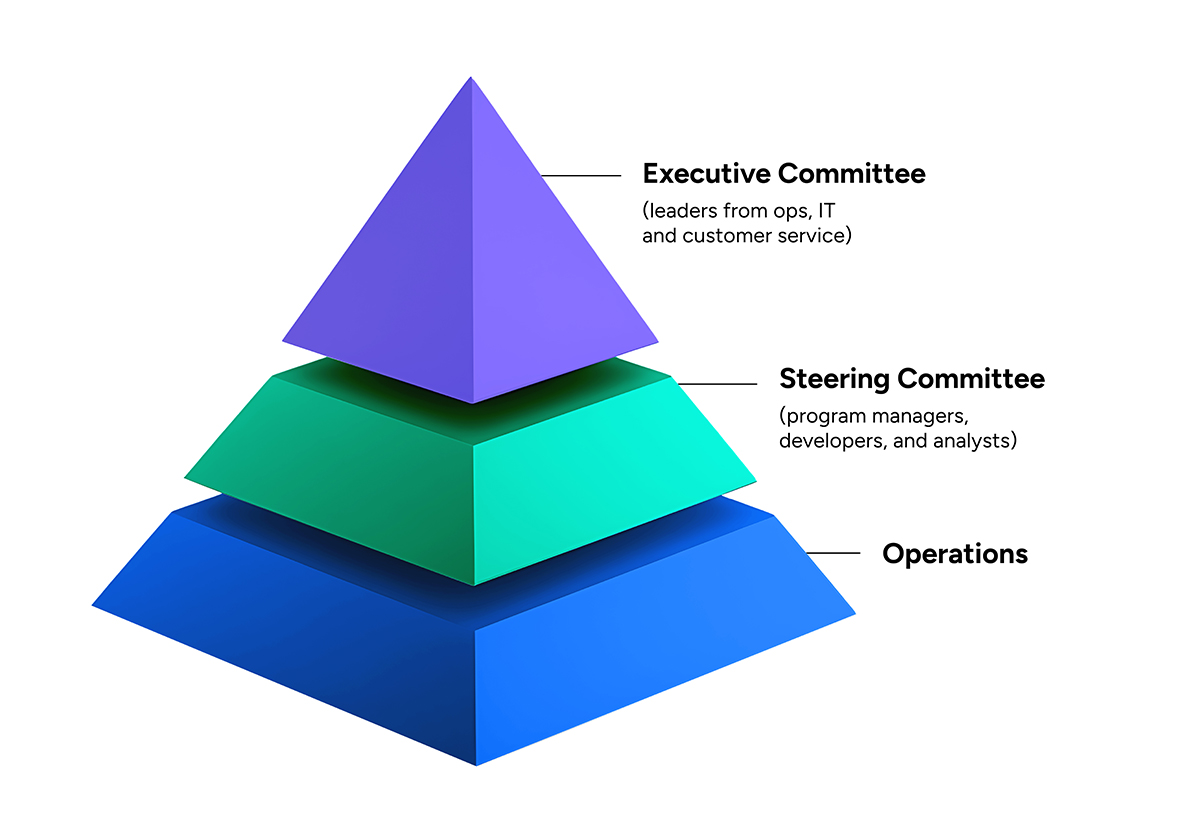
At the top: A small, empowered executive team sets controls
This team should include key leaders from operations, IT, and customer-facing functions. The emphasis is on being small; large committees often fall prey to groupthink and slow decision-making. This team owns:
- Controls and audits
- Demand and delivery management
- Performance oversight
Their role is to set the tone and direction for AI governance, ensuring it aligns with business goals and customer needs.
In the middle: A steering committee that executes the strategy
This layer includes program managers, developers, and analysts who translate strategy into execution. They champion use cases that solve real business problems and manage change across the organization. Their responsibilities include:
- Vision and strategy enablement
- Relationship and change management
- Use case discovery, design, and deployment
This group ensures that AI initiatives are not only technically sound but also aligned with organizational priorities.
At the bottom: Operations as the foundation
Operations bring together the needs of the contact center, the customer, and the product. This layer ensures that AI solutions are grounded in real-world challenges and opportunities. It’s where feedback loops are created, and where AI meets the day-to-day realities of the business. They oversee:
- Monitoring and measuring AI performance in production
- Capturing and analyzing customer and agent feedback
- Identifying optimization opportunities and feeding insights back to the steering committee
A hypothetical example of AI governance in action
Imagine a customer-centric direct-to-consumer business exploring AI to improve CX across its customer lifecycle. Initially, different teams experiment independently:
- The contact center trials voice analytics to detect customer frustration.
- Marketing deploys a generative AI assistant for personalized messaging.
- Sales tests an AI-powered knowledge base to surface relevant offers.
Without governance, these efforts remain disconnected. Voice analytics reveal common customer pain points, but those insights don’t reach the product team. Marketing’s messaging doesn’t reflect real-time customer needs. The knowledge base grows, but without input from frontline agents, it misses opportunities to improve conversions.
As a whole, performance is lackluster. Most pilots fail to scale.
Now imagine the same organization with active governance:
- A unified strategy ensures voice analytics insights inform both marketing and product updates.
- The marketing chatbot and sales knowledge base are trained on shared data, creating consistent interactions as prospects move from interest to conversation.
- The steering committee reviews feedback and AI performance regularly, identifying new use cases and piloting them quickly.
- Compliance reviews are built into the process, minimizing risk and building trust.
Suddenly, AI becomes a true growth engine.
That’s what we mean when we say AI governance, when done right, doesn’t slow innovation, it accelerates it. It creates a repeatable foundation for safe, scalable, and synergistic AI adoption over time. Organizations that embrace governance as a strategic enabler will be better positioned to unlock the full potential of AI as it continues to advance.
[cta-1]
Ready to explore how governance can elevate your AI investments? Let's chat.