
Strategies to overcome legacy tech debt and AI integration traps
Key takeaways
- Avoid the three AI traps: Organizations must navigate wait-and-see inaction, point-to-point integration bloat, and full migration endeavors to maintain a competitive edge.
- Prioritize architectural flexibility: Strategic AI adoption focuses on optionality and speed, turning flexibility into a competitive advantage that allows value to compound as models improve.
- Implement an intelligence layer: Utilizing AI Gateway decouples AI capabilities from legacy infrastructure, allowing companies to swap models and providers without rebuilding their core architecture.
When it comes to AI adoption in CX (customer experience), the tech traps are everywhere. You could:
- Wait and see until the AI market matures and never catch up.
- Bolt on point AI solutions as your tech stack sprawls and becomes unmanageable.
- Commit to a multi-year platform migration that leaves you behind competitors innovating now.
And while you’re trying to make a decision, AI capabilities keep accelerating, and the gap between customer expectations and what legacy contact center stacks can support keeps widening.
That tension drove the recent webinar, AI Adoption: The Tech Traps Nobody is Talking About, featuring Alfredo Rizzo, Chief Technology Officer at TTEC Digital, and Larry Mead, Global Lead of Experience Transformation at TTEC Digital.
This article recaps the webinar, breaking down the most common AI adoption traps in CX and exploring how leaders can escape them without waiting, creating a “frankenstack,” or needlessly rebuilding everything.
Why AI progress feels harder than it should
AI capability is evolving at an extraordinary pace, but most CX environments are not. As Rizzo explained, many organizations are balancing modern AI ambitions against infrastructure decisions that were made slowly, over decades.
“Half of the world’s contact center seats are still on premises,” Rizzo noted, pointing out that a significant portion of those environments lack a clear path to modern AI enablement.
This creates a growing mismatch. AI models and technologies continue to leapfrog one another in performance, speed, and cost, while CX platforms often require months or years to change meaningfully. According to Mead, this disconnect leads many organizations to frame AI value too narrowly.
“We’re often thinking about the business case for deploying AI in a linear fashion,” Mead said. “But we’re missing what happens when technology improves and when capabilities start working together.”
How AI value compounds through model improvements and scalability
According to Mead, AI ROI is non-linear. The compounding value of AI is the result of three specific drivers:
- User density: More users generating more data and feedback loops
- Model velocity: Rapid improvements in underlying LLM speed and accuracy
- Feature synergy: Connected capabilities reinforce each other to produce unpredictable, high-value outcomes
This is why waiting for a perfect business case can be misleading, according to Mead. Many of the most meaningful gains only emerge after teams start using AI, learning from it, and expanding into adjacent use cases.
Critical AI adoption traps for CX leaders to avoid
Throughout the webinar, Rizzo and Mead returned to three common paths CX teams take when trying to move forward with AI, and why each one tends to disappoint.
Trap 1: The risk of “wait and see” in AI adoption
For many leaders, delaying AI adoption feels like a safe option. The thinking is simple. Let the market mature, avoid early risk, and adopt later when solutions are clearer. In practice, that approach carries its own risk.
“If you sit back and wait,” Mead warned, “there’s just so much learning that happens through individuals, use cases, and feedback that you miss out on.”
While one organization waits, competitors are building experience, refining operating models, and preparing their teams for what comes next. That learning curve compounds over time and becomes difficult to climb.
Trap 2: The hidden costs of custom, point to point AI integrations
Another common response is to build custom integrations between contact center platforms and AI tools. This can feel fast at first, especially with modern development techniques.
But as Rizzo explained, every AI use case introduces another integration to maintain. Virtual agents, agent assist, summarization, analytics, and quality management often require separate connections, even when they touch the same platforms.
“Those integrations proliferate,” Rizzo said. “If something changes on the CX side or the AI side, you have to maintain and adjust all of them.”
Over time, that maintenance burden slows innovation and locks teams into aging AI capabilities.
Trap 3: Delaying AI adoption for a full migration
At the other extreme, some organizations decide to modernize everything before pursuing AI. While modernization is often necessary, tying AI progress to a multi year transformation can delay value at the exact moment when speed matters most.
“If you wait until everything is migrated,” Rizzo noted, “you may be sitting on the sidelines while competitors are already learning how to use AI effectively.”
42% of CX leaders say legacy systems are their biggest operational hurdle to CX progress. - Execs in the Know, 2025
The intelligence layer strategy: Using an AI gateway for architectural flexibility
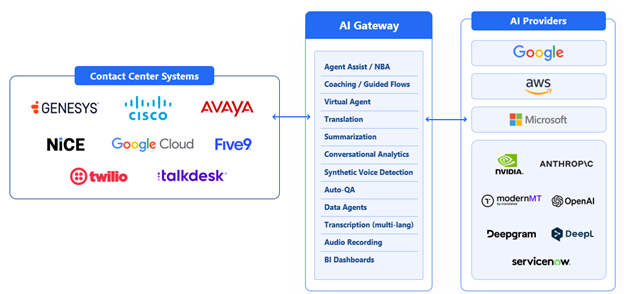
Rather than choosing between rebuilding everything or bolting AI onto legacy systems, Rizzo and Mead outlined a third path. It’s an intelligence layer that sits above core CX platforms and connects them to evolving AI capabilities.
This intelligence layer is a middleware architecture that acts as "air traffic control," centralizing routing, security, and logic so organizations can deploy AI without custom, point-to-point integrations. This solution is what TTEC Digital refers to as AI Gateway.
AI Gateway is a universal connector that ingests media and metadata from existing contact center platforms, then routes that data through chosen AI solutions via real-time APIs. AI Gateway allows users to leverage multiple frontier AI solutions in their environment, mix and switch models at any time, and ingest data from many sources with advanced AI.
Three core principles for a resilient AI strategy in CX
The webinar closed with three principles designed to help CX leaders make more resilient AI decisions.
- Prioritize architecture over features. Stop purchasing static AI features and start investing in architectural flexibility. In a rapidly evolving market, the underlying structure that allows for integration is more valuable than any single out-of-the-box capability.
- Maintain vendor optionality. Flexibility is a competitive advantage. Since no single vendor provides the "best" AI for every specific use case, organizations must maintain optionality to leverage the strengths of different LLMs and providers.
- Treat speed as a risk mitigator. Speed can function as a safety feature. By increasing the velocity of testing and learning, organizations reduce the cost of missteps and create a safer path to enterprise-wide scaling through early experimentation.
Moving forward with confidence
For CX leaders, the message in the webinar was clear. AI adoption is no longer just a technology procurement decision. It is an architectural and operational one.
The organizations that move forward successfully are not waiting for certainty. They are building flexible foundations that allow them to learn, adapt, and compound value as AI continues to evolve.
[cta-1]
Ready to bridge the gap between your legacy systems and modern AI?
Learn more about how AI Gateway can clear the path to an AI-enabled CX future.