
How Dynamics 365 Sales makes account planning actionable
Microsoft's new wave of sales agents turn account planning from a static artifact into a living system of action

Every enterprise sales team I’ve worked with has an account planning process. And in almost every one of them, the account plan itself is a slide deck or a spreadsheet that gets dusted off twice a year, updated the night before a business review, and then quietly forgotten until the next one.
We’ve all seen it. The plan looks impressive in the QBR. It maps the org chart, lists the white space, names the executive sponsors, and lays out the growth themes. Then the meeting ends, the file goes back in the folder, and the seller returns to the CRM where none of that strategy really lives. The plan and the work happen in two different places, and the plan loses every time.
Here’s the point I want to make: account planning was never a document problem. It’s an operating model problem. And if you’re running Dynamics 365 Sales, you already own most of the pieces you need to fix it.
The ingredients are already in the system
When people ask me where to start with account planning in Dynamics, my answer usually surprises them: you probably don’t need to start by buying or building much of anything. Dynamics 365 Sales already holds the facts and the work signals that a real account plan depends on: accounts and contacts, opportunity history, activities, business process flows, sequences, dashboards, forecasts, and collaboration data.
The classic methodologies like Strategic Selling and the Blue Sheet, MEDDICC, SPIN, Challenger, Sandler, value selling etc., aren’t competing philosophies you have to choose between. They’re different lenses on the same account, each inspecting a different part of the sale — qualification discipline, buying committee mapping, discovery quality, commercial insight — and nearly every one of them maps cleanly onto standard Dynamics constructs: opportunity fields and stage gates for MEDDICC, contact roles and relationship maps for Miller Heiman, discovery fields and Copilot meeting summaries for SPIN.
The gap is rarely the data. The gap is that the strategy sits in a document while the work sits in the CRM.
The shift that matters: from record to action
The single most valuable idea in modern account planning is this: treat your planning data as the source of action, not as a place to store conclusions.
In a living account plan, a strategic objective leads to an initiative. That initiative connects specific opportunities, stakeholders, activities, and review dates. Business process flows define the review path (draft, reviewed, actioned, at risk, refreshed) so the plan has a heartbeat. Sequences turn the strategy into actual seller tasks: the executive follow-up, the stakeholder mapping exercise, the renewal check-in, the next meeting. Dashboards give managers an inspection point without forcing sellers to maintain a separate tracker just for review day.
When you build it this way, the plan stops being something sellers maintain and starts being something that tells them what to do next. That’s the difference between a plan that decays and a plan that compounds.
Where agents change the equation
This is also where the newer agentic capabilities in Dynamics 365 Sales get genuinely interesting because they attack the exact failure point of traditional account planning: the manual reconstruction of the account story before every review.
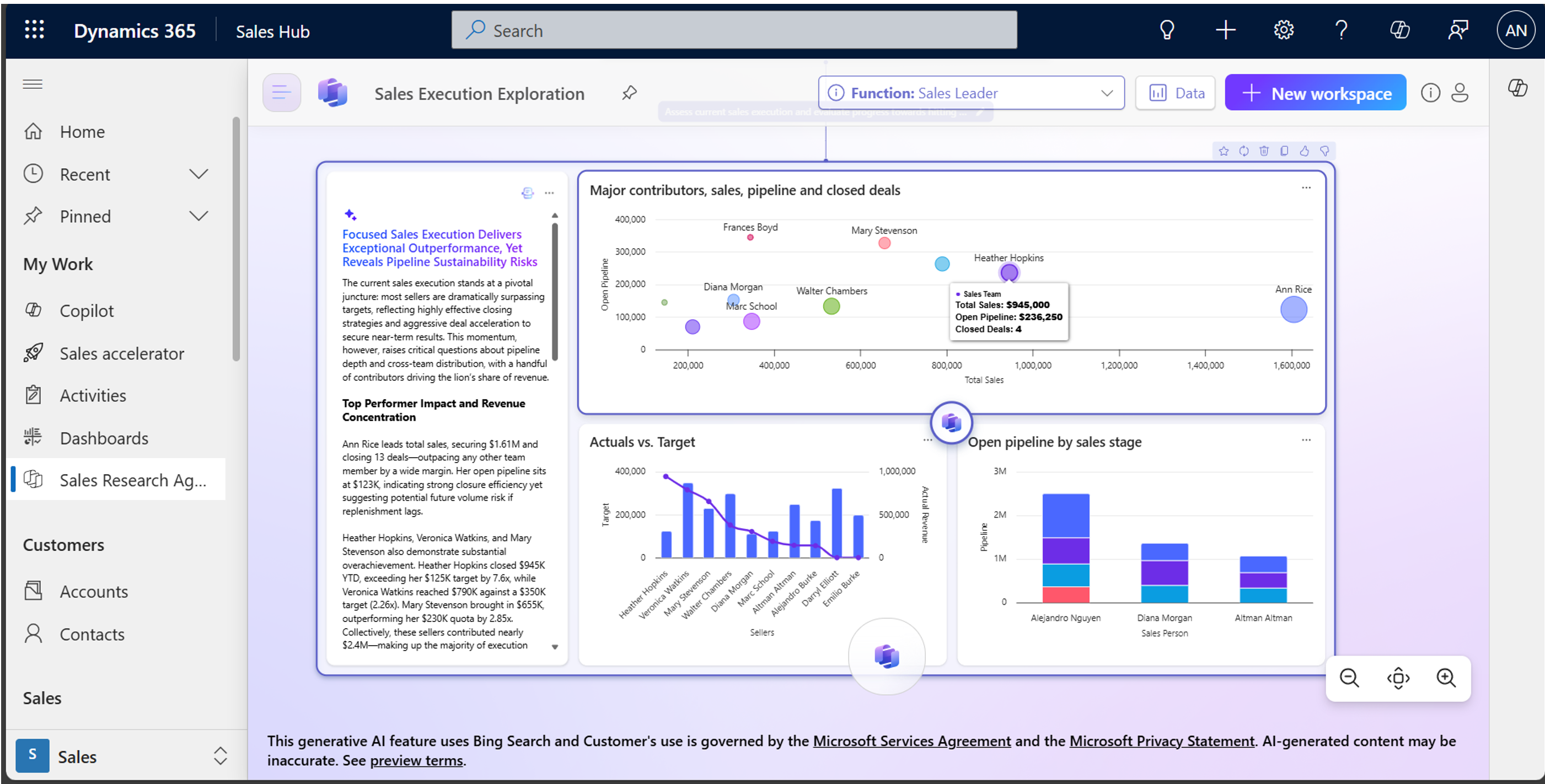
The Sales Research Agent answers questions over live, customized CRM data and returns grounded explanations instead of asking a seller to rebuild the narrative by hand for each account. Alongside it, Microsoft has documented agents for qualification, opportunity work, closing, and recommended next actions. Together they move seller work from “go dig through the CRM” to “ask, review, act.”
But we cannot forget a key principle: agents don’t fix bad data, they amplify whatever you feed them. An agent’s answer can sound completely authoritative while resting on a contact record that’s stale. So, for enterprise adoption, the right question is never “can the agent produce an answer?” The right question is: is the answer grounded in approved data, tied to your sales method, and trustworthy enough to put in front of a customer or a manager review?
Keep the core standard, add a focused layer
The mistake I see most often is teams trying to rebuild the CRM to fit their methodology. Don’t. Heavy customization of core entities makes upgrades harder, adoption slower, and drift almost inevitable.
The pattern that holds up over time is simpler:
- Keep standard sales entities as the system of record. Don’t rebuild accounts, contacts, leads, and opportunities without a compelling reason.
- Add a focused Account Plan layer tied to the account. Leverage child records for initiatives, stakeholder assessments, white space, competitor positions, relationship gaps, and account plan actions.
- Map opportunity methodology fields to the opportunity. Don’t map to the account plan, unless they describe durable account-level facts.
- Connect plan actions to sequences and recommended actions. Ensure the plan generates seller work instead of becoming one more thing to keep updated.
- Use a manager review cadence, not a wall of required fields, to drive behavior. The fastest way to push sellers back into spreadsheets is to bury them in mandatory fields.
- Measure the right things. Field completion is not adoption. It’s important to measure account plan quality, opportunity conversion, forecast accuracy, relationship coverage, and seller time saved. “Methodology theater,” or adding fields that never change how deals actually get reviewed, is the quiet killer of these programs.
Where to start
You don’t roll this out to the whole organization on day one.
The strongest starting point is a focused pilot. One strategic account segment, one account plan template, one opportunity methodology such as MEDDICC, a short manager review cadence, sequence-based follow-up actions, and a deliberately limited set of Sales Research Agent questions like account review, pipeline risk, white space, and relationship coverage.
Prove that the plan improves account reviews, seller follow-through, and pipeline decisions. Then expand.
The bottom line
Dynamics 365 Sales already has the core ingredients for enterprise account planning. The value isn’t in the ingredients; it’s in refusing to let the plan sit in a slide deck until the next quarterly review. In Dynamics 365, the plan can become the work: tasks, sequences, recommended actions, manager reviews, and agent-assisted research, all running against live data.
That gives sales leaders a system they can inspect and gives sellers a plan that tells them what to do next. That’s what a living account plan looks like, and it’s the difference between account planning as an event and account planning as a discipline.
[cta-1]
Ready to modernize your sales strategy?
At TTEC Digital, this is a conversation we love having with Dynamics 365 customers to help you turn the CRM you already own into an account planning motion your sellers use. If you’re ready to move your account plans out of the deck and into the system, let’s talk.

As a Senior Principal Architect with more than 250 deployments of Power Apps and Dynamics 365 under his belt, Joel helps companies address business challenges and empower their users and makers with AI, CRM, and low-code applications.
